

How to Ride Intercity Buses in South Korea (with a bike)
This guide also applies to those travelling without a bicycle.
It is generally simple to bring a bicycle on Korean intercity buses (see below). Carrying a bicycle on trains is much less straightforward and tickets are more expensive, which is why we focus on bus travel here.
The difficulty with bus travel is finding timetables and booking tickets without physically visiting the terminal. This difficulty is significant enough that we recommend just buying tickets at the terminal in most cases.
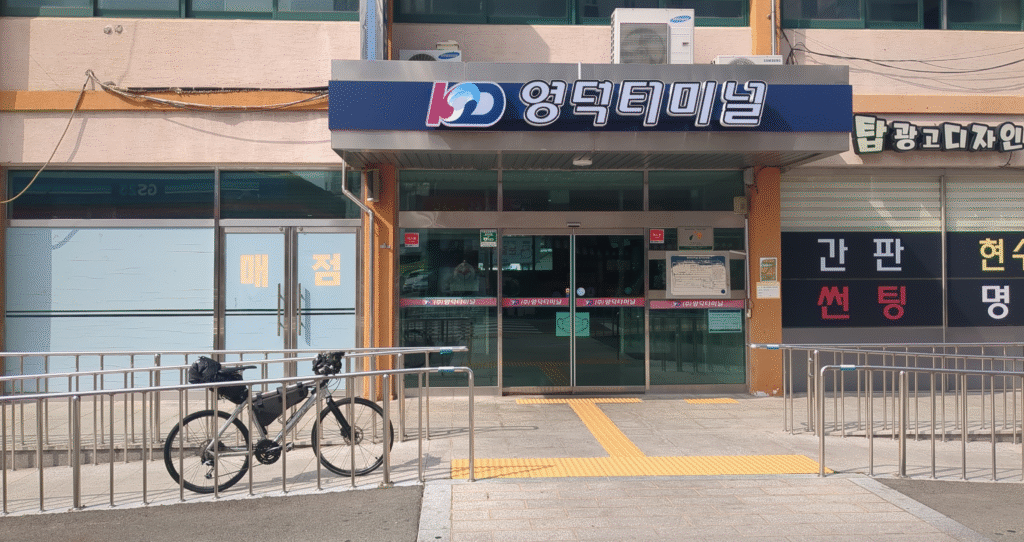
Finding the Right Terminal for your Destination
Both Naver and Kakao offer English in their mobile apps, but not on their web maps. We recommend installing one of these maps for navigation.
To find out which terminal to use, you can search for directions in the same way you would moving around the city.
Expand for step-by-step Kakao Map instructions
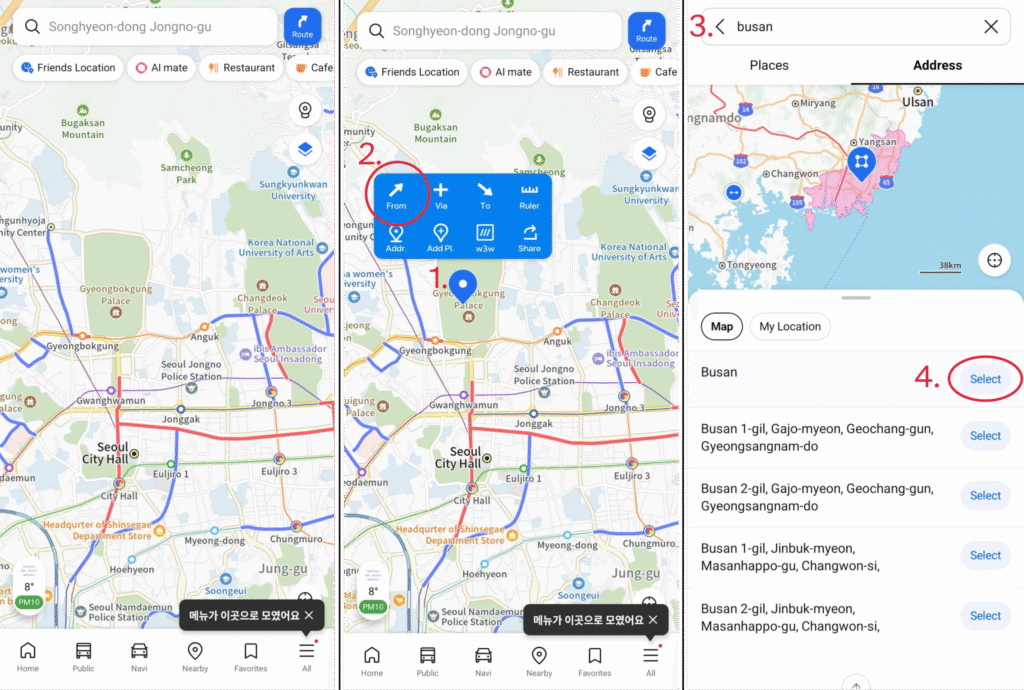
- Press and hold on the map to create a pin at your departure point, or allow GPS access
- Choose ‘from’ your departure point
- Search for your destination
- Select your destination from the options
- Scroll down to find the bus icon
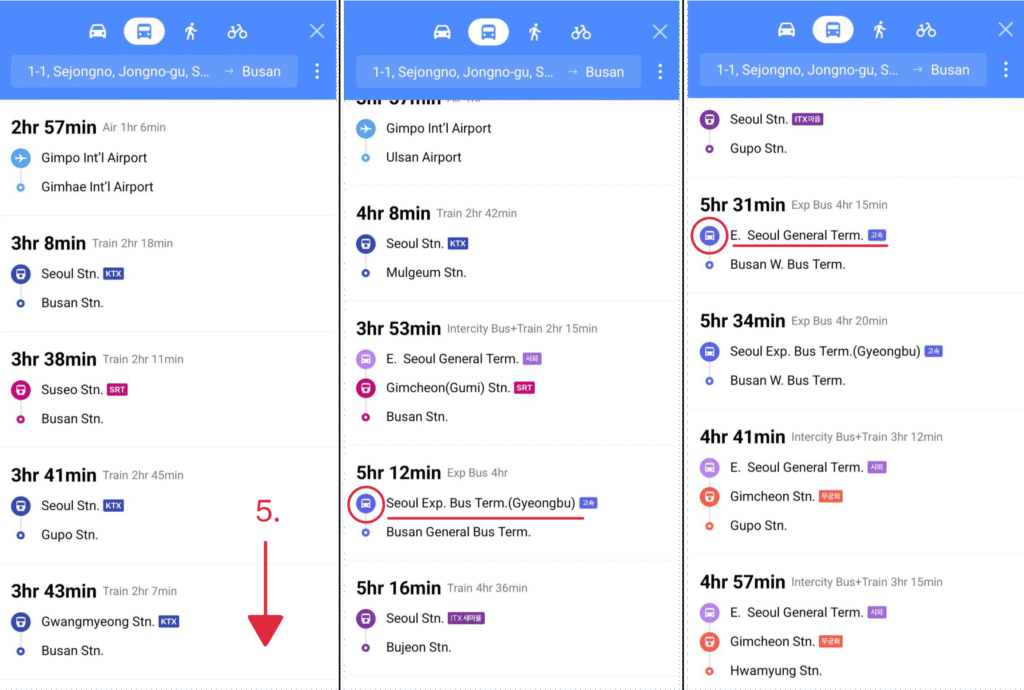
So Kakao Map is showing us that there are buses from Seoul Gyeongbu Terminal to Busan General Terminal, as well as East Seoul to West Busan.
Expand for step-by-step Naver Map instructions
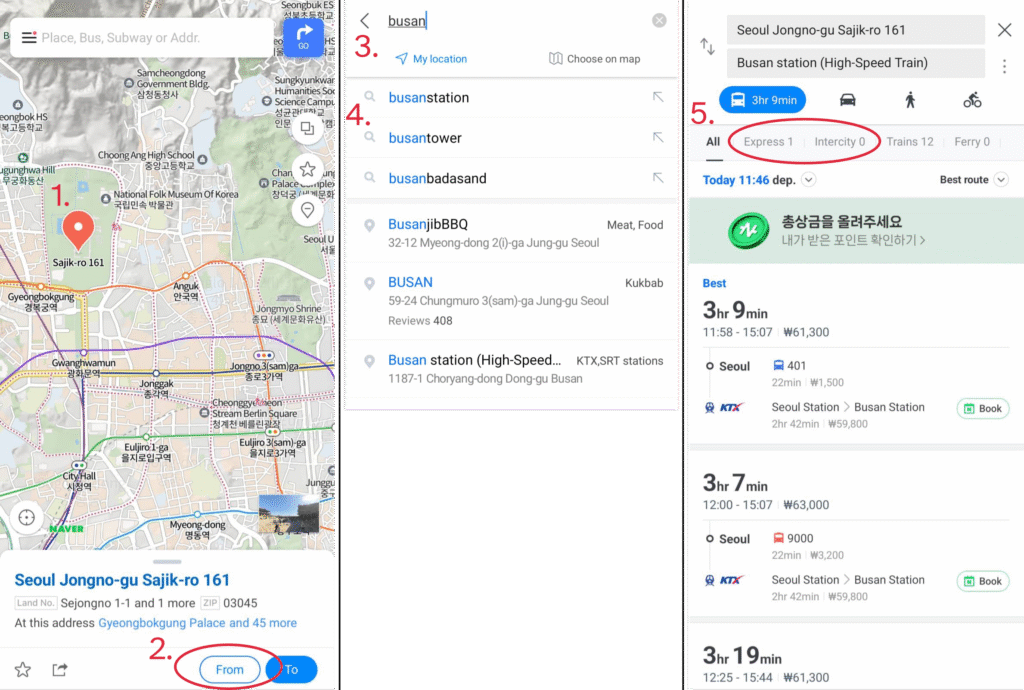
- Press and hold on the map to create a pin at your departure point, or allow GPS access
- Choose ‘from’ your departure point
- Search for your destination
- Select your destination from the options
- Select ‘Express’ or ‘Intercity’ to filter buses only
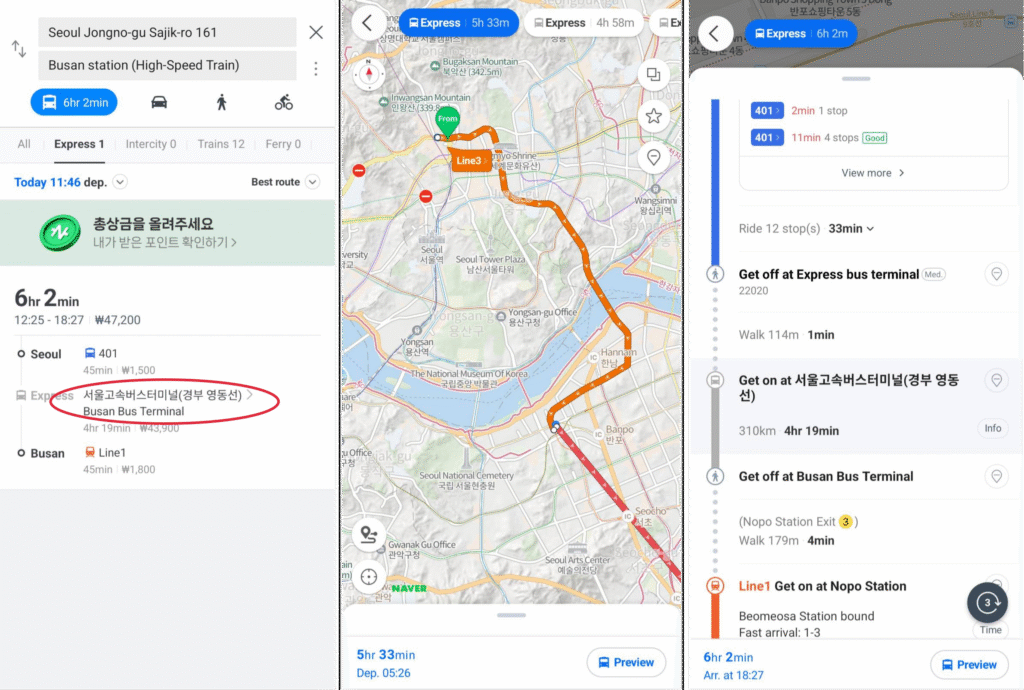
Naver tells us the terminal, but displays the name in Korean. If you tap the route suggestion and swipe down, you can see the location of the terminal on the map.
Do I need to check Bus Schedules in advance?
Bus schedules on routes between large cities work with intervals of an hour or less, so travellers with relaxed schedules going to or from Seoul might get away without checking the timetable.
What you must check beforehand is which terminal you need for your destination, as major cities in Korea often have multiple bus stations.
If your departure or arrival point is a smaller town or city, it’s important to check the schedule in advance as there may only be a few services per day.
Jump to How to find Timetables
Seoul Bus Terminals
Seoul has four express terminals:
- Gyeongbu and Central City – next door to each other in Gangnam
- Dongseoul – East Seoul, next to Gangbyeon Station Line 2.
- Nambu – an old terminal directly south of Gyeongbu, serving some rural areas
Gyeongbu and Central City serve different areas of Korea.
You can find which terminal you need by searching Naver or Kakao maps for directions to your destination.
Language Tip
For those without knowledge of Korean, these four words will get you a long way when it comes to navigating buses:
북 [buk] – North
동 [dong] – East
남 [nam] – South
서 [seo] – West
This will help you understand bus terminal names like Dong Seoul, Nam Seoul, Seo Daegu.
Buying Tickets
Buying bus tickets online without a Korean card is difficult and in many cases impossible.
Instead, we recommend buying tickets at the terminal.
This does of course come with the risk of the bus you want selling out, but this can be mitigated if you arrive early enough that there are plenty of buses still to come.
Bringing a Bicycle on Intercity Buses
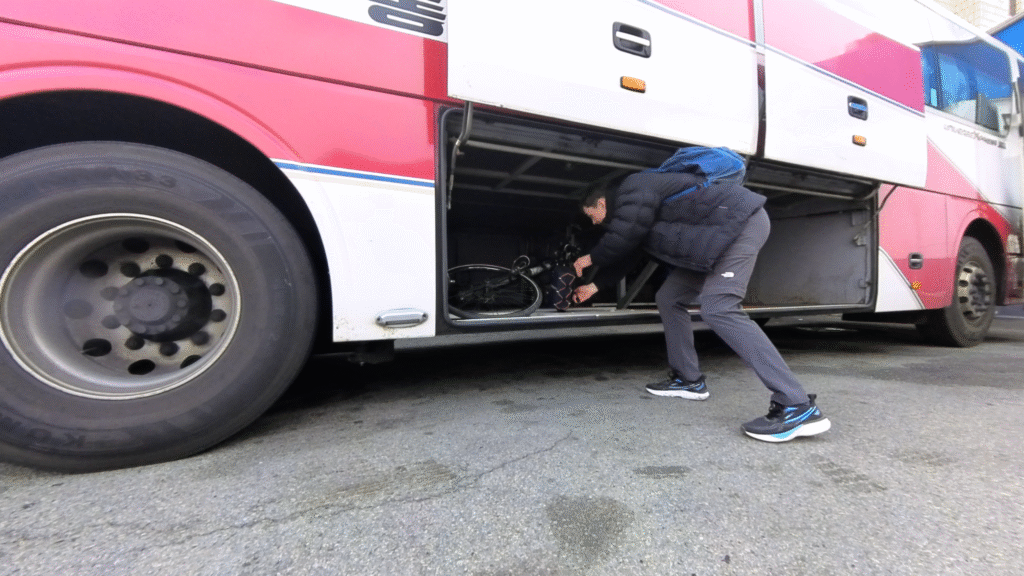
This is an area where our experience conflicts with information online.
In our experience, it is possible to simply walk up to the bus with your bicycle and stow it in the luggage compartment, without dismantling it. Besides a few frowns, bringing a bicycle doesn’t require advance booking, sweet talking of the driver, or disassembly. The driver usually leaves you to open the door yourself and definitely won’t help you to lift the bike into the compartment – but won’t make it a problem.
However, there are stories online of people being refused boarding, and rumours that bicycles need to be dismantled or even boxed.
We can’t discount these stories, and therefore repeat earlier advice: be at the bus station early enough in the day that any issues can be solved by waiting for the next bus.
Why it’s hard to find Timetables
While Naver and Kakao can show you which terminal to go to, they don’t present timetable information well at all.
This is actually a systematic problem in Korean transportation services. Intercity buses are managed by various companies and local governments, so collecting and updating all of the schedule information is very difficult.
The only tools we know of which do this successfully are Tmoney Go (mobile app, find buses and buy tickets) and Asamaru (web, timetable information only), however these are only available in Korean.
How to find Timetables
Timetable information and online booking for parts of the bus network is available in English on the following websites:
Note that these websites may not work outside of Korea.
No one of these platforms lists all of South Korea’s bus terminals. For example, of the four main terminals in Seoul, Kobus has Central City, Gyeongbu and East Seoul, while Bustago and TxBus both have Nambu and East Seoul.
When you click on the departure field, all three of these websites bring up a dialogue like the one below from Kobus.
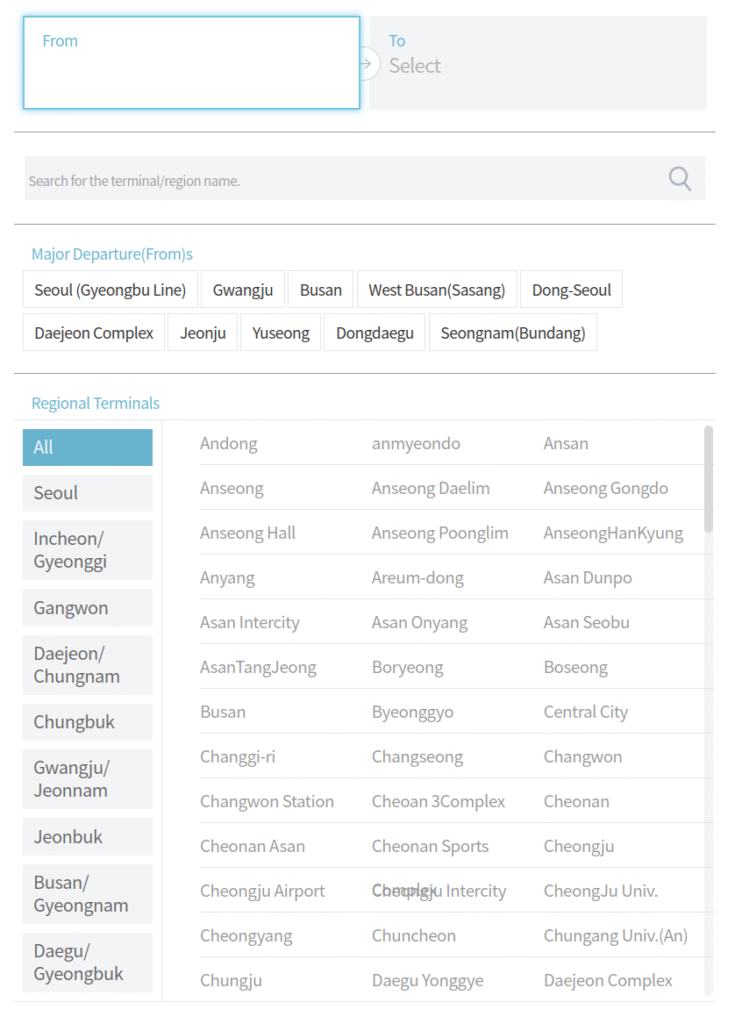
If you’ve already found out which terminal you need from Naver or Kakao, you can search for that terminal here. If it doesn’t appear, try one of the other sites.
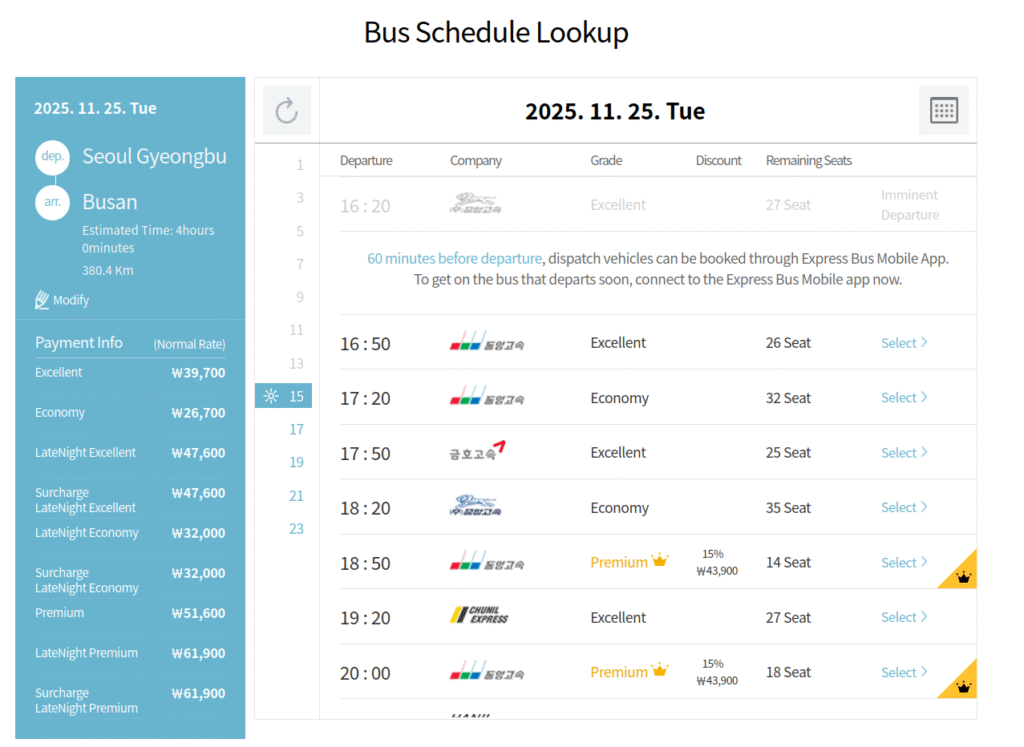
Now we can see departure times and pricing.
Buying Tickets Online
If you keep clicking through after finding the bus you want, you will arrive at the payment form. Unless you have a Korean card (or friend) this is as far as you’re likely to get.
While foreign cards mostly work in shops and ATMs, they cannot be used for online payments in Korea. This is why we strongly recommend buying tickets at the terminal itself.
Still need help?
Get in touch for personal advice and support here.